Exhibitions at ISAW
Upcoming Exhibition:
TEMPLE AND TOMB
Prehistoric Malta, 3600-2500 BCE
March 21 - July 7, 2013
Located between southern Italy and the northern coast of Africa, the Maltese archipelago was home to an astonishing and artistically rich prehistoric culture. During the later Temple Period (ca. 3600–2500 bce), the early Maltese constructed extraordinary megalithic complexes to house cultic and funerary rituals, and produced an outstanding range of aesthetically refined representations of the human form Learn more >>>
Past Exhibitions:
ECHOES OF THE PAST
The Buddhist Cave Temples of Xiangtangshan
September 11, 2012 - January 6, 2013
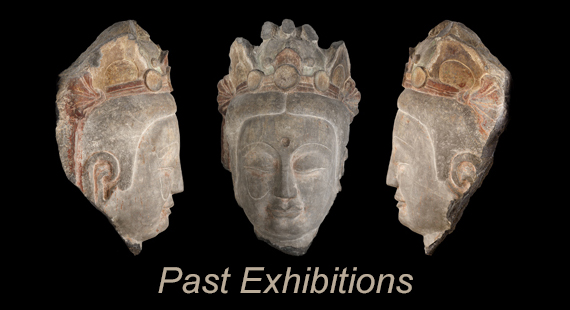
“Echoes of the Past” unites a group of imposing sculptures from the Northern Qi period (550-577 CE) Buddhist cave temple complex at Xiangtangshan in northern China with a full-scale, digital, 3-D reconstruction of the interior of one of the site’s impressive caves. This innovative installation provides an unprecedented insight into the original setting for these remarkable sculptures by marrying twenty-first-century digital techniques and ancient objects. The sculptures are extraordinarily accomplished Learn more >>>
NOMADS AND NETWORKS
The Ancient Art and Culture of Kazakhstan
March 7 - June 3, 2012
Nomads and Networks is the first U.S. exhibition to provide a comprehensive overview of the fascinating nomadic culture of the peoples of eastern Kazakhstan’s Altai and Tianshan regions from roughly the eighth to first centuries bce. With over 250 objects on loan from Kazakhstan’s four national museums, the exhibition provides a compelling portrait that challenges the traditional view of these nomadic societies as less developed than sedentary ones. Learn more >>>
![]()
Edge of Empires: Pagans, Jews, and Christians at Roman Dura-Europos
September 23, 2011 — January 8, 2012
This exhibition vividly illustrated the international, pluralistic character of Dura-Europos, a city strategically located high above the Euphrates River, between Syria and Mesopotamia. The exhibition focused on its final phase, in the third century CE, when Dura-Europos served as an important Roman stronghold on the empire’s eastern edge. Many of the objects included demonstrate the coexistence of multiple religions—including polytheistic cults, Judaism, and Christianity—the great variety of languages employed by its population, and its role as an international military garrison. Learn more >>>
Nubia: Ancient Kingdoms of Africa
March 11 — June 12, 2011
This exhibition featured over 120 objects illustrating the remarkable and distinctive aesthetics of Nubian art. The exhibition traced Nubia’s rich culture, which flourished in present day Sudan and southern Egypt, from its earliest kingdoms (3200–3000 BC) to the Kushite period (900–400 BC) during which Nubians rose to conquer Egypt and fought against the Assyrian empire. Learn more >>>
Before Pythagoras: The Culture of Old Babylonian Mathematics
November 12, 2010 — January 23, 2011
This exhibition is the first to explore the world of Old Babylonian mathematics through cuneiform tablets covering the full spectrum of mathematical activity, from arithmetical tables to sophisticated work on number theory and algebra. Learn more >>>
The Lost World of Old Europe: The Danube Valley, 5000 - 3500 BC
November 11, 2009 - April 25, 2010
In 4500 BC, before the invention of writing and before the first cities of Mesopotamia and Egypt were established, Old Europe was among the most sophisticated and technologically advanced regions in the world. This exhibition presented extraordinary finds from the three countries with the richest Old European archaeological heritage—Bulgaria, the Republic of Moldova, and Romania. Learn more >>>
Wine, Worship and Sacrifice: The Golden Graves of Ancient Vani
March 12 - June 1, 2008
Spectacular finds from two sanctuaries and four tombs illustrate that ancient Colchis was at the crossroads for many different peoples from the early fifth to the first centuries B.C. Learn more >>>