ISAW hosts LMU-NYU joint workshop on the materialities of ancient texts
At the end of last month, researchers from Ludwig-Maximilians-Universität München (LMU) convened with colleagues here at ISAW for a two-day workshop (Apr. 30–May1, 2026) on the theme of the “Materialities of Ancient Texts.” (See papers presented below.)
The Materialities of Ancient Texts workshop was almost exactly a year in the planning and only made possible by the generous support of the LMU-NYU Research Cooperation. This program was established in 2017 and extended in 2022 to promote and support research collaboration between LMU Munich and New York University (NYU) across disciplines and levels. In this case, the grant supported two activities: an exchange of junior researchers between ISAW and LMU; and a workshop at ISAW on April 30–May 1, 2026.
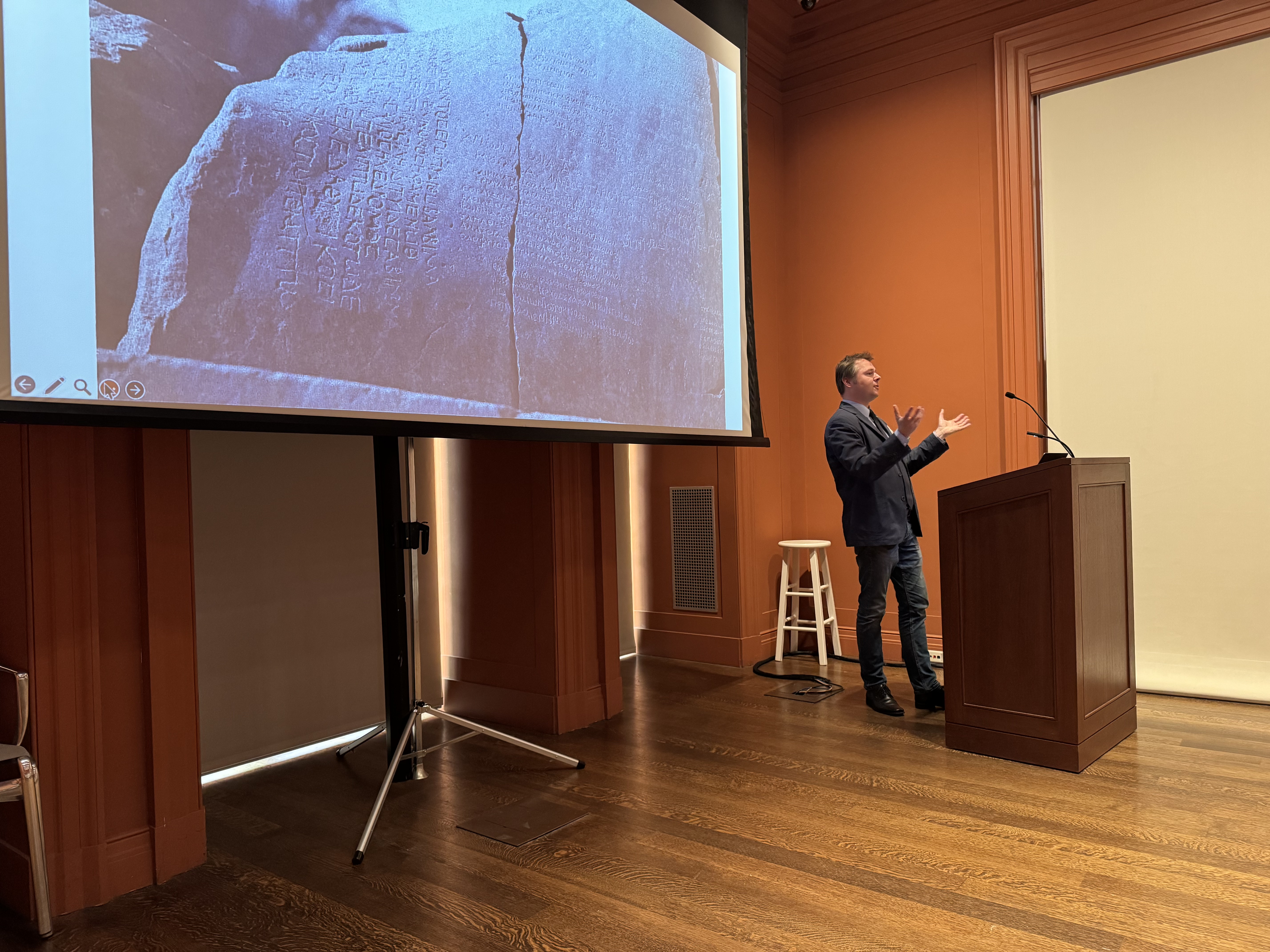 Alexander Free (LMU) presenting in the ISAW lecture hall on the inscribed poems on the Colossus of Memnon in Egypt.
Materiality was chosen as the theme for our joint workshop not only because it is implicated in the research programs of many of the scholars both at ISAW and LMU, but also because it was slated to be the topic of a team-taught graduate seminar at ISAW in Fall 2025. This seminar explored the theorization of the concept of “materiality” with specific focus on its methodological deployment in the study and analysis of textual or inscribed objects. As is often the case at ISAW, this seminar included presentation and participation by several ISAW faculty, students, and several Visiting Research Scholars. It therefore seemed a promising topic for a joint workshop between ISAW and several of the ancient institutes, faculties and departments at LMU: we could use the seminar as springboard to prepare and debate several of the key aspects of the materiality of ancient texts before convening, and indeed many of the participants in the seminar presented research developed in the seminar at the workshop.
For those initiated into the mysteries of materiality studies, one of the challenges in determining precisely what one means by “materiality”; and then, if successfully defined, how best to deploy the concept in order to arrive at a new perspective or result when it comes to some very old materials. That is to say that while "materiality" may seem at first glance to be a self-evident concept, one soon discovers significant differences in the ways in which it is theorized, invoked, and employed by those who study textual objects, with a particular divide between those who come from fields that privilege language (e.g., epigraphy, papyrology, Assyriology, Egyptology, and history) and those who approach such objects from the perspectives of material or visual culture (e.g., archaeologists and art historians).
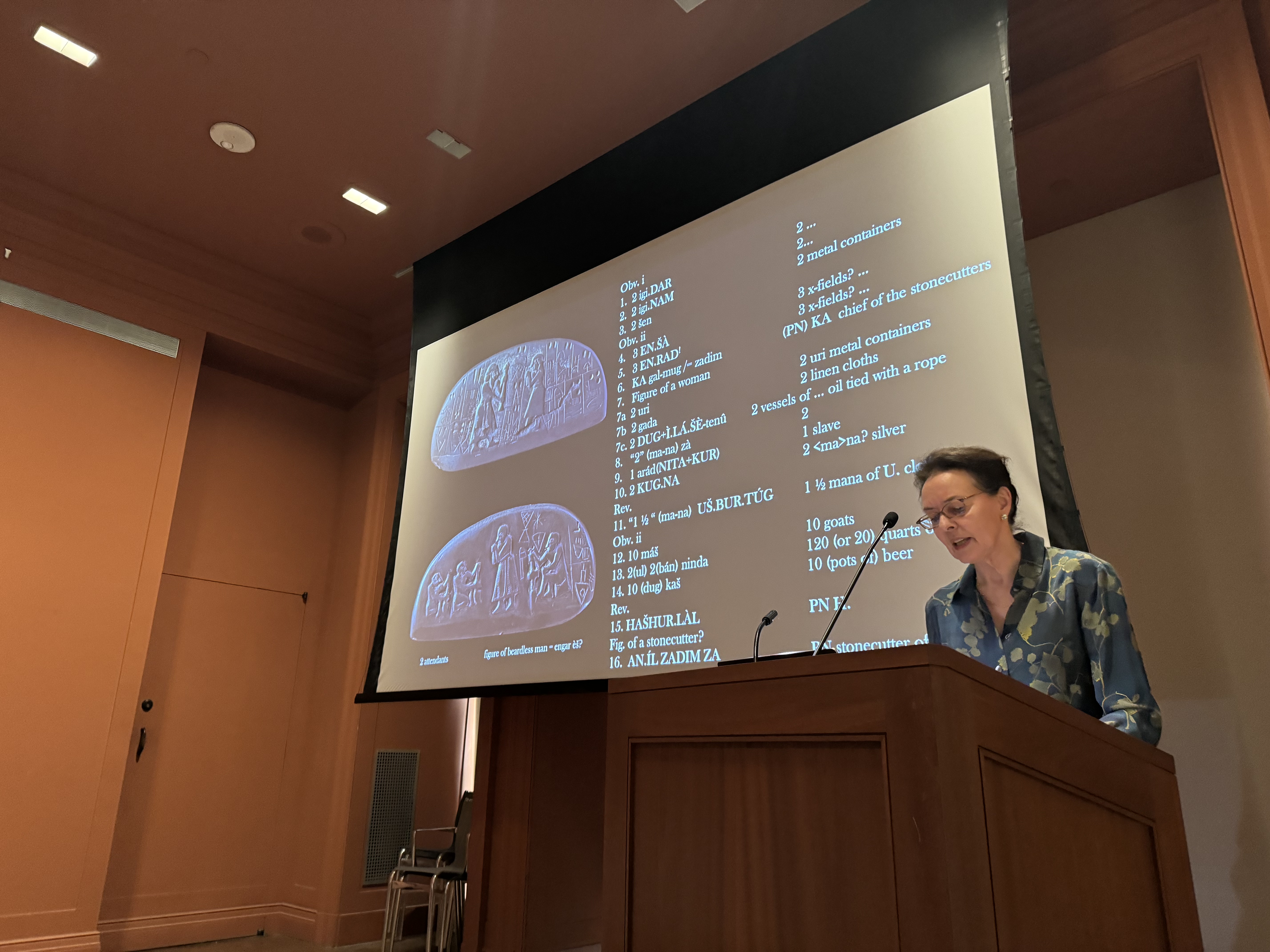 Beate Pongratz-Leisten (ISAW) presenting in the ISAW lecture hall on the Blau Stones at the joint LMU-NYU workshop on the materialities of ancient texts.
Scholars from those fields that study texts in the first instance have embraced the “material turn” over the past twenty-five years by engaging in what has recently been called an “extended hermeneutics.” Such scholars self-consciously depart from the practice of the past century, when texts were often published with little to no information about (much less analysis of) the media or objects which carried them, by studying and integrating observations about the practices and affordances associated with the production, use, circulation, and preservation of textual objects, their embeddedness in networks of human and non-human actants, and their evolving transformations, recontextualizations, and reception over time. A basic assumption of this approach is that the “meaning” of a text is not fixed but emergent; and further that its materiality is necessarily constitutive of that meaning, often in ways that support or overlap with the semantic content of the text, but also in ways that may sometimes ignore or even negate it. That said, materiality in this view almost always remains instrumental to semantic interpretation: the text is the point of departure and final object of analysis.
For those whose point of departure is material culture, on the other hand, dealing with materiality necessarily involves wrestling with the complex entanglement of humans with things, things with humans, and things with other things. The study of the materiality of a text-bearing object from the archaeological or art historical perspective answers the question, “how does this object qua object participate in the entangled materiality of the community in which it is embedded, which community certainly includes non-readers and other objects?”
As we discovered in the seminar, we live in a world of varied and sometimes contested materialities on multiple levels, a realization readily provoked by the inherent complexity of textual objects. The workshop was devoted both to the exploration of particular materialities of ancient texts and to establishing dialogue between different understandings and orientations to materiality as a lens through which to study ancient textual objects. The hope was to provide not only a space to work with any definition, application, or operationalization of materiality, but also a forum for productive discussion about the commensurability of the various approaches to and aims of whatever theory or method of materiality participants may advance over the course of the workshop.
Program: April 30, 2026
9:00: Welcome to ISAW and Materialities of Ancient Texts (David M. Ratzan, ISAW)
Ancient China
9:10: Inscribed Objects, Empire, and Everyday Life in Han China (Lillian Tseng, ISAW)
9:50: War and Writing in Pre-Imperial China: Inscribed Weapons in Archaeological Context (Maria Khayutina, LMU)
Ancient Near East
11:00: Estimating textual abundance in antiquity: the case of the cuneiform extispicy omen corpus (Mary Frazer, LMU)
11:40: Writing on the Body: Inscriptions on the Early Dynastic Mesopotamian Statues (Yu Song, ISAW)
12:20: Between Material and Materiality: The Blau Stones in Historical-Epistemological Perspective (Beate Pongratz-Leisten, ISAW)
Late Bronze and Archaic Eastern Mediterranean
14:00: Materiality of Writing in Post-Hittite Syro-Anatolia: A Quantitative Analysis of Monumental Inscribed Objects (Manolis Mavromatis, ISAW)
14:40: Re-materializing the Alphabet: Embodied and Material Entanglements in Phrygian Writing Practice(s) (Christina Stefanou, ISAW)
15:20: Inscribed Armor, Personhood, and the Materiality of Writing in Archaic Crete (Antonis Kotsonas, ISAW)
Keynote Address
16:45: “Wedge-shaped, wooden, once-sealed: Is there a text in this class?” (Divya Kumar-Dumas, University of Maryland)
19:00: Dinner (for speakers only)
Program Day 2: May 1, 2026
9:00: Welcome to Day 2 of Materialities of Ancient Texts (Moritz Hinsch, LMU)
Materiality, papyrology and empire
9:10: The Things We Leave Behind: Papyri, Materiality, and Documentary Practice Across the Greco-Roman World (Matthias Stern, LMU)
9:50: Empire and individual on sherds of clay (Michael Hahn, LMU)
Materiality, classical literature and religion
11:00: Letters to the Gods? The Materiality of Writing Oracles (Moritz Hinsch, LMU)
11:40: Materiality and intertextuality, or why it matters that we know how much books cost in the Roman world (David M. Ratzan, ISAW)
12:20: Hearing the holy voice of Memnon, I missed you …”. The Memnon Colossi and Material culture (Alexander Free, LMU)
Materiality and late antique documentary and administrative practices
14:10: Materiality of ancient papyrus petitions: A case study from 4th century Egypt (Giulia Grossi, LMU)
14:50: Cross meets Crescent: The materiality of Early Islamic documentary papyri and the pagarchs under Arab rule (Younes Köhler, LMU)
Panel Discussion and Concluding remarks
16:00: Reflections on the proceedings (Jonathan Leite, Lauren Malkoun, Anna Selden, Greg Woolf, ISAW)
16:45 Concluding remarks on the workshop (Alexander Free, LMU)