ISAW Library Internship Report: Discovery and the Nina Garsoïan Collection on Armenian Language & History
As the Spring 2026 semester concludes, so does my time as a dual-degree student in the MA/MLIS program between NYU and Long Island University. Beyond the MA in Near Eastern Studies from NYU's Hagop Kevorkian Center and the MLIS from LIU's Palmer School of Library and Information Science, this program has given me the chance to develop both the hard and soft skills of library technical services across many of NYU's libraries. I owe particular thanks to Gabriel Mckee and Patrick J. Burns at the ISAW Library. They built my cataloging foundations so that I could produce quality records and become more efficient at the work itself, all while keeping me current on developments at the forefront of the field, particularly in contours and trends of metadata and the growing nexus of philology and technology. They were always open to taking the time to discuss topics that interested me and provided me with the chance to apply my linguistic training to materials that require special attention to ensure their discoverability for patrons. ISAW's library was an important incubator where my MA and MLIS training came together in the direction of the academic library career I want to pursue.
I came to ISAW as a cataloging intern for the Nina Garsoïan collection, charged with creating records for a vast, unprocessed, and uncataloged body of Armenian and related-language materials. Nina G. Garsoïan, born in Paris in 1923, was a foundational figure in Armenian studies in the United States. She had a long career at Smith, Columbia, and Princeton, including a term as Dean of the Graduate School at Princeton and the chair of Columbia's Department of Armenian History and Civilization. ISAW received the first installment of her library in March 2016, and the remainder in December 2022. The donation centers on Armenian history but ranges widely, with materials in Armenian and many other languages. Many of the Armenian-language titles are otherwise difficult to find in American libraries, especially on the East Coast. The majority of the collection was processed several years ago, but a large backlog of material in Armenian and Georgian, requiring specialized cataloging, remained. My goal for the semester was simple in principle and substantial in practice; to find, remediate, and create records that would make these materials discoverable to future scholars and patrons, and to ensure that Nina Garsoïan's gift becomes genuinely usable to the scholarly community to which she gave it.
The reach of these records extends well beyond ISAW. Original cataloging contributed to the cooperative library organization OCLC is taken up and lightly adapted by other libraries that hold the same titles, including many institutions without staff who can read or evaluate the original-language portion. This asymmetry is most acute for materials in non-Roman scripts, where a record's reliability cannot be as easily assessed. A record built on bulk machine transliteration or de-transliteration of a Classical Armenian title, or one that silently merges Reformed and Classical orthographies, does not stay an isolated error but moves through copy cataloging into every institution that uses that record. [Some works, like Վրաց աղբյուրները Հայաստանի յեվ Հայերի մասին / Vratsʻ aghbyurnerě Hayastani yev Hayeri masin (Georgian Sources on Armenia and the Armenians), posed interesting orthographical puzzles.] A record lacking an original-script access point will, in most cases, produce copies that lack one as well. In languages where North American catalogers trained to evaluate works are few, original-script inclusion and careful authority control should be implemented in the source record as early as possible, not in some later round of remediation that many institutions cannot perform.
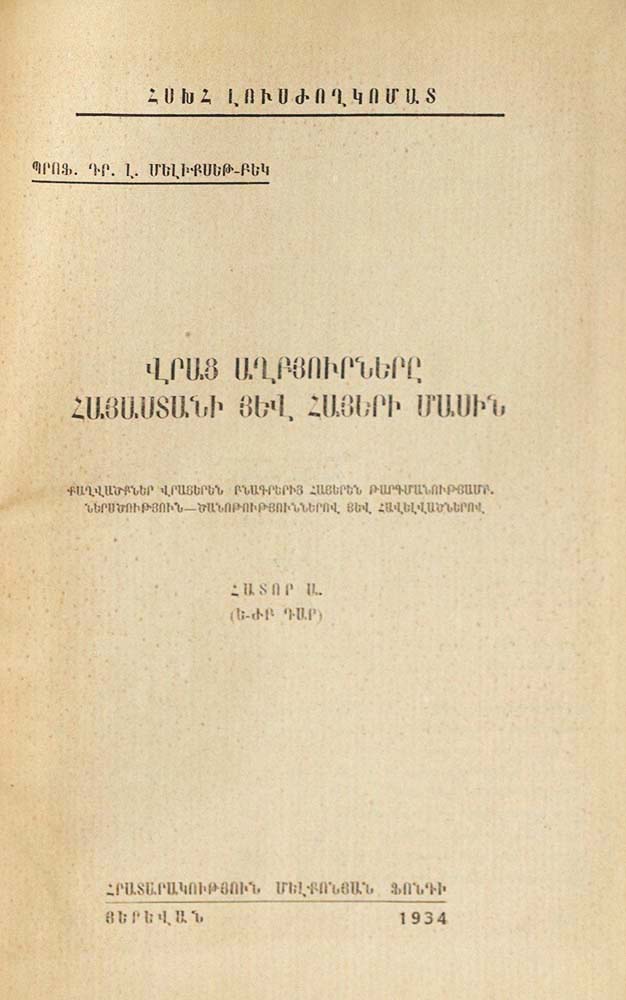 The collection's copy of Վրաց աղբյուրները Հայաստանի յեվ Հայերի մասին / Vratsʻ aghbyurnerě Hayastani yev Hayeri masin (Georgian Sources on Armenia and the Armenians) is a Soviet-era volume printed in an earlier form of reformed Armenian orthography that temporally sits between the Classical Mesropian standard still used in much of the diaspora and the current reformed orthography of the Republic of Armenia. The title page is in neither of those forms, and cataloging it well meant making its record not only representative of the item, but having the volume be findable to readers searching in current orthographic standards.
Working with Gabriel translated my prior theoretical training in cataloging and metadata into sustained practical workflows and processes. I came out of the semester confident in creating original records and cataloging best-practices, as well as with a substantive understanding of the particular issues that arise with cataloging an array of languages. My work at ISAW was wonderfully interesting as it pulled on every part of my linguistic training. Armenian and Russian were the daily languages, but Georgian, Greek, Hebrew, Arabic, Persian, French, Italian, and German all surfaced. From my earliest experiences in library work, I have been most drawn to questions of access for non-Roman script materials, which face persistent and well-documented disadvantages in catalog discoverability compared to their Latin-script counterparts. One commitment I have held onto wholeheartedly throughout my time in the library space is the inclusion of the original script in records, and updating legacy records, wherever possible, rather than relying on ALA-LC romanization alone. ALA-LC tables serve an important function; however, they are also opaque to most patrons and carry a real learning curve, especially for native speakers with certain languages. Records built only on romanization tend to fail precisely the readers with a high level of linguistic expertise– the readers who are most likely to come looking for the material. Doing my job well meant learning the common pitfalls of bulk machine transliteration that are common in Armenian records, distinguishing carefully between Classical and Reformed Armenian orthography, and providing original-script access points where none existed in Armenian, Russian, Georgian, Arabic, Persian, etc. The collection gave me a fairly unusual chance to put my own background in these languages directly to use, supplying multilingual descriptions and access points that a cataloger without this combination of training would have had to outsource or leave aside. A collection this multilingual was not only engaging but a real practical induction to high quality cataloguing in the most absolute sense of the term.
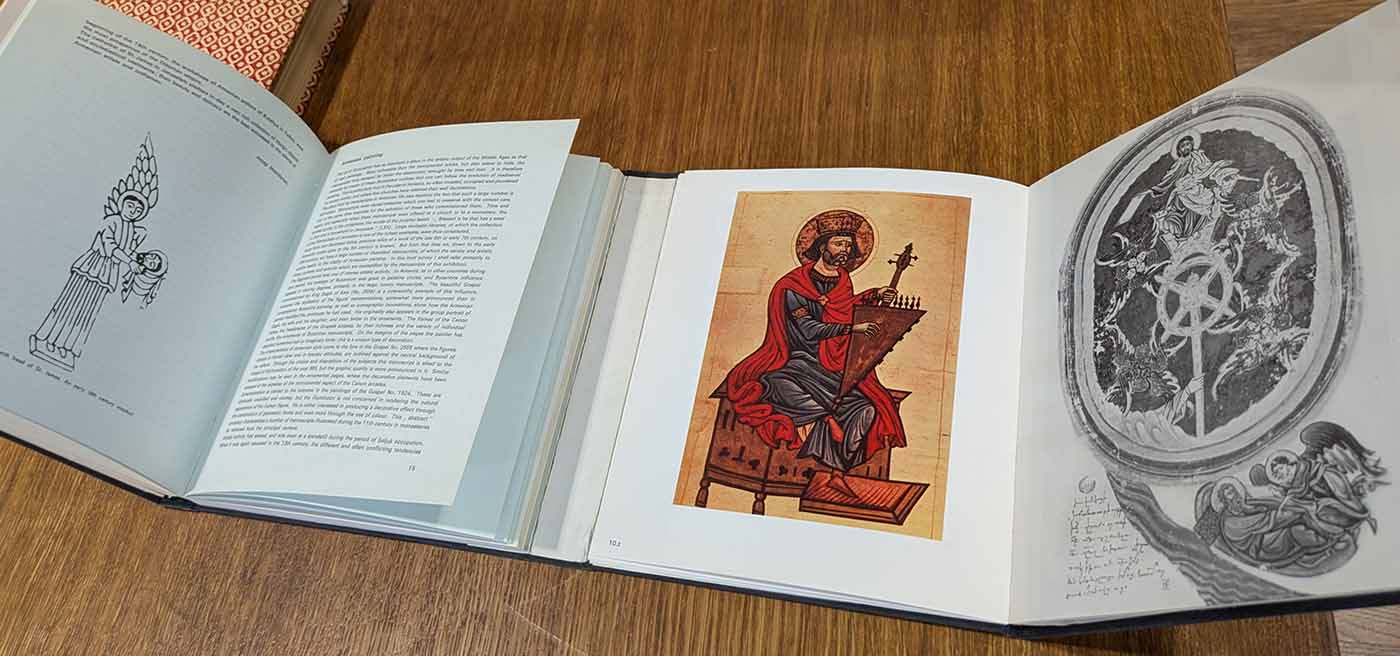 An opening from Երուսաղէմի Հայոց Պատրիարքարանի գանձերը / Treasures of the Armenian Patriarchate of Jerusalem (1969), an exhibit catalog in an unusual French door binding (with two separate text blocks side-by-side).
Many of the volumes in the collection are multilingual at the level of the individual book, not just across the collection. Title pages in three, four, or five scripts are common. From Jerusalem, the collection includes Arpag Mekhitarian's Երուսաղէմի Հայոց Պատրիարքարանի գանձերը / Treasures of the Armenian Patriarchate of Jerusalem (1969), the catalog from the inaugural exhibition at the Helen and Edward Mardigian Museum. The text runs in five languages (Armenian, English, French, Hebrew, and Arabic) across 49 plates of art and reliquary objects. The ISAW copy interestingly has a French-door style of binding, with two parallel text blocks running side by side that the reader opens like a pair of double doors, easing the reader’s task of mapping correspondence between photos of the catalog and its descriptions. The small 1964 guidebook to the Azərbaycan Tarixi Muzeyi (Museum of History of Azerbaijan) does something comparable in a different format, presenting its contents in Azerbaijani Cyrillic, Russian, English, French, German, Arabic, and Persian. Items like these were excellent training in the distinct considerations and workflows that proper description in each language requires. Although Armenian is the predominant non-Roman script in the Garsoian collection, working through these materials provided me with hands-on experience across a range of languages and scripts as expansive as the collection itself.
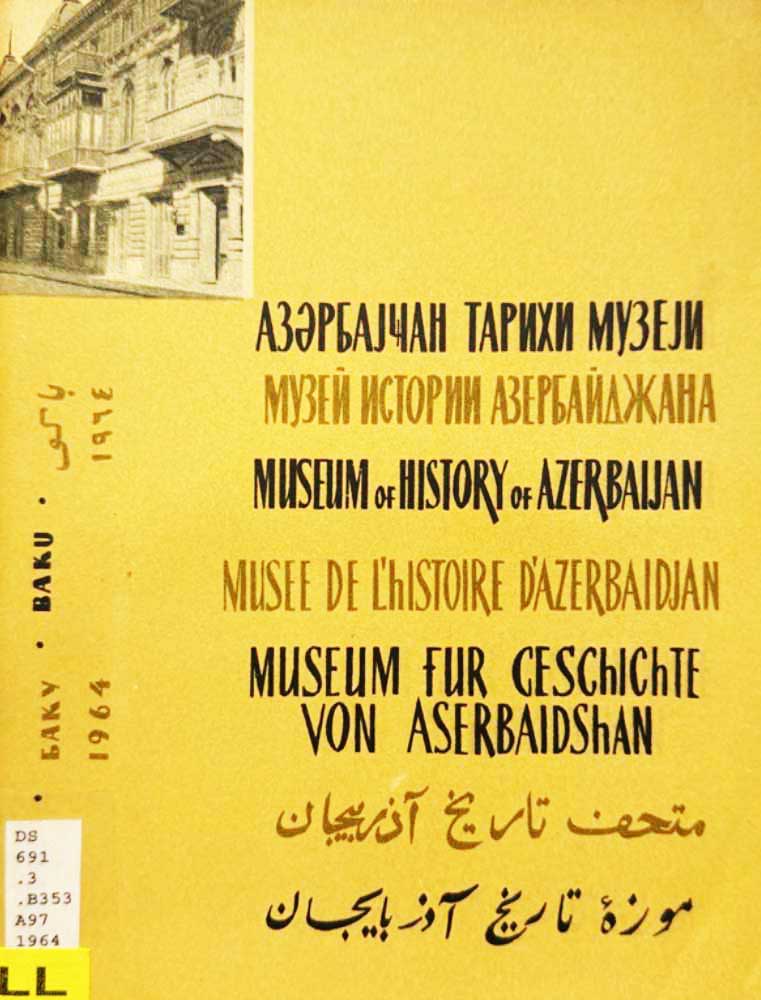 The collection's guide book for the Azərbaycan Tarixi Muzeyi from the Azərbaycan SSR Elmlər Akademiyası. Beyond the multilingual nature of the book, care was also taken in the selection of the typeface/calligraphic style for the Arabic and Persian titles; Naskh for Arabic and Nasta’liq for Persian, although both share a Soviet flair like the Cyrillic and Latin lettering above.
Working at ISAW allowed me to further put the concepts of well structured and discoverable cataloging and metadata into practice. Cataloging is, in the end, a quiet form of academic generosity. The records we make determine whether materials are found and used. My deepest thanks again to Gabriel Mckee and Patrick J. Burns for their patience, generosity with their time, and willingness to allow me to grow into the work over the course of the semester. Thanks as well to the wider staff and community at the ISAW Library for making it such a welcoming place to spend my final semester at NYU. I am leaving with skills, instincts, and friendships that I did not have when I arrived, and with a real sense of where I would like my future career to take me.